
How a Turbocharger Works
How does a turbocharger work?
When it comes to diesel engine performance, few components are as important as the turbocharger. Modern diesel engines rely on turbochargers to deliver more power, better fuel efficiency, and reduced emissions without significantly increasing engine size. But how exactly does a turbocharger work, and why is it so effective?
The Role of a Turbocharger in a Diesel Engine
One of the key differences between a turbocharged diesel engine and a naturally aspirated gasoline engine is that the air entering a diesel engine is compressed before fuel is injected. This compressed air contains more oxygen, creating the ideal conditions for a stronger and more efficient combustion process.
A turbocharger's primary function is to force more air into the engine's cylinders than would naturally enter under normal atmospheric pressure. As air is compressed, oxygen molecules are packed closer together, allowing the engine to inject and burn more fuel. The result is increased horsepower, improved torque, and greater overall efficiency.
This added efficiency also allows manufacturers to use smaller engine designs while maintaining impressive power output. The benefits include:
- Increased engine performance
- Improved fuel economy
- Reduced vehicle weight
- Better engine packaging and design flexibility
- Lower emissions through more efficient combustion
How a Turbocharger Works
A turbocharger consists of two main sections: the turbine side and the compressor side. These two components work together to convert otherwise wasted exhaust energy into usable engine power.
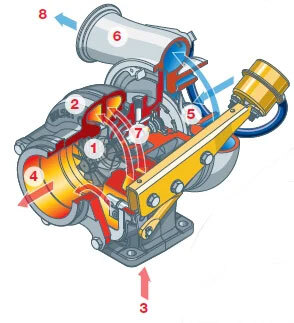
1. The Turbine Side
The turbine section captures energy from the engine's exhaust gases.
Key components include:
- Turbine Wheel (1)
- Turbine Housing (2)
As exhaust gas (3) leaves the engine, it enters the turbine housing, where it is directed onto the turbine wheel. The force of the exhaust flow causes the turbine wheel to spin at extremely high speeds, often exceeding 100,000 RPM.
After transferring its energy to the turbine wheel, the exhaust gas exits through the exhaust outlet area (4) and continues through the exhaust system.
2. The Compressor Side
The compressor section uses the rotational energy created by the turbine to compress incoming air.
Key components include:
- Compressor Wheel (5)
- Compressor Housing (6)
The turbine wheel and compressor wheel are connected by a forged steel shaft (7). As the turbine spins, it turns the compressor wheel at the same speed.
The compressor wheel draws fresh air into the turbocharger and accelerates it outward at high velocity. The compressor housing then slows the airflow through a process known as diffusion, converting velocity into pressure. This creates a stream of compressed air (8) that is delivered directly to the engine's intake system.
The result is a denser charge of oxygen-rich air entering the cylinders, allowing the engine to burn more fuel and generate significantly more power.
Turbocharger Component Breakdown
 |
The major components of a turbocharger include:
|
Each component plays an essential role in converting exhaust energy into increased engine performance.
Why Turbochargers Are So Effective
A turbocharger is essentially a power-recovery device. Instead of allowing exhaust gases to leave the engine as wasted energy, it captures that energy and uses it to compress incoming air.
This process provides several valuable advantages:
More Power Without a Larger Engine
Turbocharging allows a smaller engine to produce the power output of a much larger naturally aspirated engine. This concept, known as engine downsizing, helps manufacturers meet modern performance and efficiency requirements.
Better Fuel Efficiency
Because the engine can generate more power from each combustion cycle, less fuel is required to achieve the same performance level compared to larger non-turbocharged engines.
Improved Torque
Diesel engines are known for strong low-end torque, and turbochargers further enhance this characteristic. Increased torque improves towing capability, acceleration, and overall drivability.
Reduced Emissions
More complete combustion means fuel is burned more efficiently, helping reduce particulate matter and other emissions while improving fuel economy.
Final Thoughts
Turbochargers have become a cornerstone of modern diesel engine technology. By harnessing energy from exhaust gases and using it to compress incoming air, turbochargers allow engines to produce more power, better torque, and improved fuel economy without increasing engine size.
Whether you're operating a pickup truck, commercial vehicle, agricultural machine, or industrial diesel engine, the turbocharger plays a vital role in maximizing performance and efficiency. Understanding how it works helps operators and technicians appreciate one of the most important innovations in modern engine design.
Recent Posts
-

Donaldson Filtration - Filters that Work
Filtration That Works as Hard as Your Equipment When your equipment is pushed to its limits, your …Sep 17th 2026 -

Stanadyne Fuel Additive Products
Advanced Protection for Today's Diesel Fuel Systems Modern engines rely on highly sophisticated fuel …Aug 18th 2026 -
How a Turbocharger Works
How does a turbocharger work? When it comes to diesel engine performance, few components are as im …Aug 7th 2026